










Integrate local SEO with the Listings API
Listings API is a REST API for local SEO with typed Python and Node SDKs and a hosted MCP server. You publish a business to multiple citations from one write, read and reply to reviews, post, and read analytics, then embed all of it in your own product under your own brand.
Listings API vs legacy platforms vs building it in house
| Listings API | Legacy platforms | Build in house | |
|---|---|---|---|
| Integration model | REST API, typed SDKs, hosted MCP | Dashboard or platform | You wire each integration |
| Primary interface | API plus your own UI | Vendor dashboard | Whatever you build |
| AI agent access | Hosted MCP at listingsapi.com/mcp | No MCP server today | You build your own |
| Citation reach | Multiple citations from one write | Platform managed | Per directory work |
| Time to live | Self serve, key and first call | Sales led onboarding | Months of build |
| Maintenance | We maintain every citation sync | Vendor maintained | You maintain it forever |
| White label | Embed under your own brand | End user platform | Your brand, your build |
| Pricing and contract | $99 and $499, month to month | Custom quote, annual | Engineering cost |
Published tiers versus custom quotes
Why teams pick Listings API
API first, built to embed
Listings API is a REST API with typed Python and Node SDKs. You call it from your product and render local SEO inside your own screens. The enterprise platforms are end user dashboards first; the thing you buy is their UI, not your integration.
AI agent native
A hosted MCP server runs at listingsapi.com/mcp, alongside llms.txt, an auth guide, an MCP server card, an agent skills index, an API catalog, and WebMCP tools. An agent can discover and call listings, reviews, and posts without a human clicking through a dashboard.
REST, typed SDKs, and a playground
One API key, sent on every request as Authorization: API and your key. Typed Python and Node SDKs, a hosted MCP server, and a playground mean your team reads a spec and ships, instead of booking an onboarding.
Published pricing, month to month
Launch is $99 a month for 4 locations. Growth is $499 a month for 25 locations. Enterprise is custom for 100+ locations. 14 day free trial, cancel anytime, no sales call. The enterprise platforms are sales led on custom annual quotes.
One surface, four capabilities
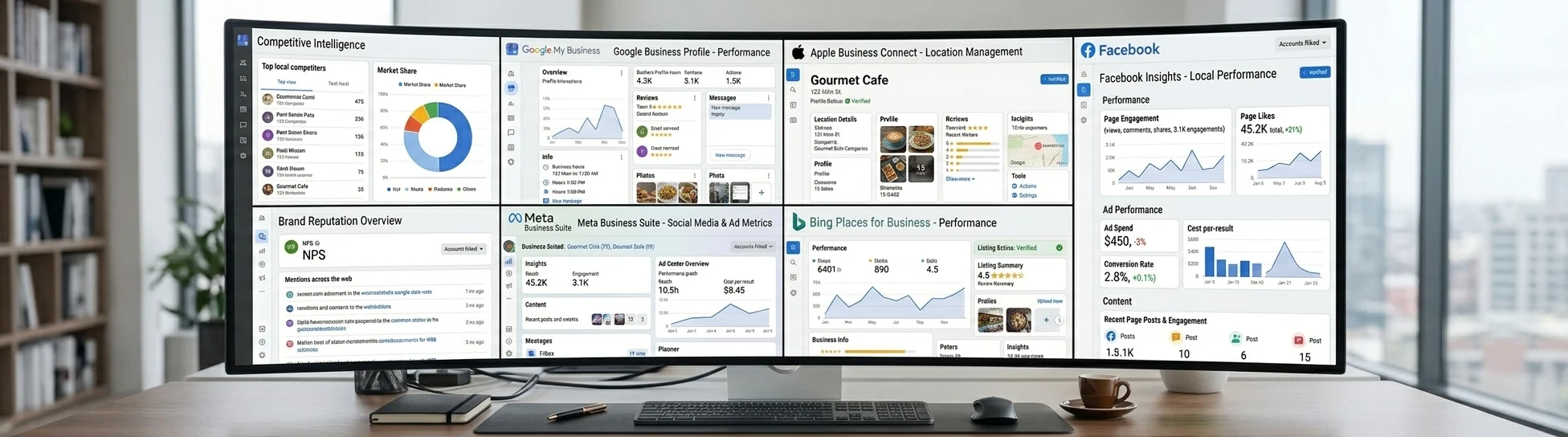
Listings sync across every citation, review read and reply on Google and Facebook, posts on Google and Facebook, and analytics reads from Google, Bing, and Facebook. One key, one API, all four, with per citation sync status readable back.
White label under your brand
Embed listings, reviews, posts, and analytics into your own product under your own name. Your customers see your brand, not ours.
Build vs Buy: Why Developers Should Not Build Their Own Listings Syndication System
An agency or enterprise client that wants to manage listings across Google, Apple Maps, Bing and other premium directories can become expensive to support. Each publisher has its own pricing, API documentation,strict data validation rules, requirements and tech stack. Integrating and maintaining 50+ publisher networks can take months or even years and requires a dedicated engineering team, significantly increasing development and maintenance costs.
Let me walk you through the build vs buy decision for listings sync in details. What building actually involves, what it really costs and why using APIs from ListingsAPI is the better call for almost every agency or clients.
Similarly you would not build your own payment processor. You would not build your own email delivery service. You use providers like Stripe and you use a transactional email provider because those platforms solved a difficult, tedious, ongoing problem so you don’t have to manually build and integrate with your system or platform. Listings sync belongs in the same bucket. It may look simple but integrating each network site does take a lot of time, engineering work and cost.
What building actually involves
Let's take the question at face value: how hard is it to build listings sync in-house across 50 directories?
The honest answer is that it is not just one project. It is 50 separate projects, each with its own API docs, integration requirements, error handling and maintenance during their new version upgrade. There is no standard or common protocol. Every directory has its own path and what data they accept.
A handful of premium directories have API documentation like Google Business Profile, Apple Maps and a few more. But even those are gated, Google does not provide Business Profile API access to anyone with a Cloud project. You have to apply through a contact form and Google's own prerequisites few of them are requiring OAuth 2.0 authorization, active access token rotation pipelines etc. Even with approval, the limits can become a challenge when you’re syncing thousands of locations with photos, business hours, special hours, attributes and other data. An in-house built system must transform a single database entry into 50 custom JSON or XML structures before sending updates
Another group of directories works through data feeds or partner programs. Getting those takes emails, calls, contracts and sometimes minimum volume commitments.
A final group is fed by data aggregators which push business data downstream to hundreds of smaller sites. Working with aggregators means more contracts, more feed formats and more waiting periods because aggregator updates can take weeks or months to publish.
So 50 plus directories really means a few gated APIs, a pile of partner feeds, several aggregator relationships and a long list of sites with no clean way to publish. Each one needs its own authentication, its own field mapping, its own error handling, and its own monitoring.
Directory updates rarely process instantaneously. When a platform receives business updates, the data passes through internal verification queues or manual moderation stages. An internal syncing system must track data states, such as pending, active or rejected status, across all connected platforms. Managing network timeouts, partial rejections, duplicate listing suppression and status verification across 50 plus endpoints requires job queues and custom retry logic.
Every directory has its own tech stack and requirements
Even after you get access, the data management and sync issue arises. One publisher has its categories from its own fixed list. Another uses a totally different category list, so you need mapping between them and your own system’s list. Data validation rules like one accepts 24 hour time for opening hours, another wants AM/PM, a third has special rules for split hours and special or holiday hours. Photo requirements differ in size, format, and count that can be published. Some sites accept special characters in business names while others reject them.
Another problem you will come across is silent failure which is the worst part. A submission can be accepted and then never published on their site. A listing can be published and then overwritten weeks later by stale data from an aggregator or a user edit. This is called listing drift and it means sync is not a one time push. It is a loop that compares two sets of records to ensure they match. You have to keep checking what each publisher site actually shows, compare it against the data you submitted and re-submit when there is a mismatch. Building the data push is maybe a third of the work. Building the verify and repair loop is the rest.
The APIs are not constant, their version keeps changing
Whatever you build today may change tomorrow. APIs get deprecated and re versioned. Google, Facebook are a few examples who have restructured its APIs and deprecated versions several times which breaks existing integrations. Partner feed specs change. Rate limits change. Category lists change. A team that builds in-house adds up for huge maintenance work that arrives on the directories schedule and this scope rarely stays only at listings. The moment listings integration is done, someone asks for review monitoring across those same sites. Then review responses. Then posts to Google and Facebook. Then analytics on how listings perform. Each of those multiplies the integration work all over again.
The real cost: building a citation feature vs buying an API
The cost of building- Now let's put numbers on it.
Lets be generous and assume a small and efficient team with few backend engineers and a product manager. Integrating the gated APIs, negotiating and wiring the aggregator feeds, building the field mapping, the submitter and service classes, the retry logic and the reporting is certainly 6 to 12 months of work. At typical engineer costs, that first build lands somewhere between $250,000 and $500,000 before a single customer location syncs.
Then comes the part most build estimates leave out. The long-standing industry rule, often credited to Gartner and confirmed by decades of enterprise data, is that annual software maintenance runs 15 to 20 percent of the initial build cost, every year. For a $400,000 build, that is $60,000 to $80,000 a year just to keep the integration working. And listings syndication sits at the high end of the maintenance because the external surface is so large and so unstable. Fifty integrations means fifty things that can break.
Add the costs that never show up in the sprint plan: the weeks spent waiting for Google API approval, the months negotiating aggregator contracts, the support tickets when a client's listing shows old hours or stale data. That last one, every quarter your team spends maintaining the directory integrations which can be spent on new features that actually win you customers.
The cost of buying
ListingsAPI starts at $99 per month, runs month to month with no annual contract and comes with a 14-day free trial with the launch plan. It covers more than 50 directories, including Google Business Profile, Apple Maps, Bing Places, Yelp, Facebook, Hotfrog, Waze, MapQuest, Yellow Pages and the long list of citation sites that teams will take months or years to integrate and maintain one by one.
Run the comparison over three years. Building: $250,000 to $500,000 up front, plus $60,000 to $80,000 a year in maintenance. Buying a subscription that starts under $1,200 a year and scales with usage, with zero integration maintenance on your side. Even on the growth plan at $499 per month, three years of ListingsAPI subscription costs less than one month of in-house integration build effort.
What you actually get when you buy
Price is only one of the segments. The others are what an API first product gives you that an in-house build struggles to match.
ListingsAPI is one API for the whole local search problem: citation publishing, review monitoring and responses, posting and analytics. You create a location once and publish it to multiple publisher sites then get back live sync status per site along with the live links, so your product or application can show customers exactly where their data stands.
Instead of writing 50 plus custom request handlers, teams submit business profile data to a single endpoint at Post /api/v4/locations. Our system formats the payload and publishes data to over 50 plus listing sites including Google Business Profile, Apple Maps, Bing Places, Facebook, Hotfrog and MapQuest. Business data updates, such as changes to phone numbers, hours, or street addresses, use POST /api/v4/locations/update to update all connected network profiles using one endpoint.
Developers can check sync progress by making a request to Get /api/v4/locations/{id}/listings/premium. This call yields structured JSON data showing specific sync states such as synced or in_progress alongside live link URLs of listing sites. This removes the need to build custom web scrapers or perform manual verification checks.
ListingsAPI handles additional local presence requirements through its developer platform. Software applications can retrieve customer reviews across networks and post responses using POST /api/v4/locations/reviews/respond. Your system can broadcast updates or promotional offers across profiles by posting using POST /api/v4/posts. In addition, local search statistics and interaction metrics are available via endpoints like GET /api/v4/locations/{id}/google-analytics.
It is built to embed and provide simple integration solutions. Legacy platforms in this space were designed as end user dashboards first, with APIs available on later and often only partially. ListingsAPI works the other way around. You render listings management inside your own application and under your own brand. Your customers see your product and that matters for agencies, white-label platforms, franchise systems and any SaaS tool that wants listings as a feature.
It also avoids the legacy pricing trap. The established players in listings management sell on custom quotes, annual contracts, and sales led onboarding. Yext, Synup, Uberall, BrightLocal the best known of them are widely reported to run into thousands of dollars per location per year on annual terms. ListingsAPI publishes its prices, bills monthly and lets you cancel any time, which means you can start with testing the integration and adding test locations on a free trial and scale from there.
ListingsAPI offers official SDKs for Python (pip install listingsapi) and Node.js, allowing developers to work with typed objects in native application code so the first integration is hours of work rather than months.
If your roadmap includes agent driven workflows, a capability you could use is our hosted MCP server at listingsapi.com/mcp. AI tools connect directly using commands such as claude mcp add --transport http listingsapi https://listingsapi.com/mcp, allowing automated agents to verify listing statuses, read reviews, and post updates without writing custom network code.
Most important of all: when a directory changes its API or deprecates an endpoint, that is ListingsAPI's problem. Our team maintains every citation sync. Your integration keeps working. This maintenance work is all dealt with by ListingsAPI.
A short decision test
Before your team writes any code, answer four questions honestly. First, will customers pay more because the integrations are yours or do they only care that listings sync data are correct? Second, can you commit two developers not just to the build but to the maintenance, every year? Third, have you priced the wait, days of Business Profile history before Google approval or Apple’s approval, plus months of aggregator negotiations, against a competitor who ships the same feature next week on an API? Fourth, what would those developers build instead and what is that worth?
If you work through those questions and building in-house still wins, you are one of the rare exceptions. For everyone else, the answer was decided the moment the feature request landed.
Conclusion
Building listings sync, review management, multiple channel posting and pulling analytics in-house across 50 plus directories is not a sprint or two. It is a six figure initial build, a permanent maintenance tax of 15 to 20 percent of that build every year, an organization works hard through API approvals and aggregator contracts and a standing distraction from the product work that actually grows your company. And at the end of it, you own a worse version of something you could have rented for as small as $99 a month.
Start a free trial at ListingsAPI, sync a location this week and let us handle the infrastructure while your team focuses on building great products.
FAQs
Is this an API or a dashboard?
It is a REST API with typed Python and Node SDKs and a hosted MCP server. There is a playground to try calls, but the product is the API you build on, not a dashboard your customers log into.
How does authentication work?
One API key, sent on every request as the header Authorization: API followed by your key. No OAuth dance and no per call signing.
How many places does one write publish to?
Multiple citations across directories, maps, and answer engines from a single write. You can read per citation sync status back through the API.
What can I do beyond listings?
Review read and reply on Google and Facebook, posts on Google and Facebook, and analytics reads from Google, Bing, and Facebook, all from the same API.
Do I have to talk to sales?
No. Launch and Growth are self serve with a 14 day free trial, month to month, cancel anytime. Enterprise for 100+ locations is the only tier that is custom.
What is a listings API, and how is it different from a business data API?
A business data API reads what already exists about a business. You query it and get back whatever has been collected or scraped, and nothing you send changes what the world sees. A listings API writes. You send one canonical record, the name, address, phone, hours and categories, and it publishes that record to directories, maps and social profiles, then keeps them in sync as the record changes. That difference decides what you can build. Read only data lets you audit a business and report on it. A listings API lets you fix one. It is the difference between telling a client their hours are wrong on eleven sites and correcting all eleven from a single call. The distinction shows up again in what comes back. A data API returns a snapshot. This returns a record per citation with its own sync state, so you can ask whether each directory actually accepted the write rather than assuming it did, and show that answer in your own interface.
Can I white-label it and ship it under my own brand?
Yes, and the API stays invisible by design. Your customers see your product, your interface and your brand. Calls run server side under one key, so there is no Listings API login for them and no co-branded dashboard in their path. The one place a third party appears is connecting a Google or Facebook profile. That runs through an OAuth link the business owner has to open and authorize, because only those providers can grant access to their own accounts. Everything after it is your screens. This is a different thing from what white-label usually means in this category, which is re-skinning someone else's dashboard with your logo and colours. There the product is still their platform and your customer still signs into it. Here there is no dashboard in your customer's path at all. You build the interface and this is the infrastructure under it, which is what makes it work for agencies, franchise systems and any SaaS tool that wants listings as a feature rather than a referral.
Why not just build it in house?
You can integrate Google Business Profile, Bing, Facebook, and each directory yourself, then maintain every one as their APIs change. Listings API is that integration and its upkeep, behind one key.
Start integrating in minutes
Create an account, get an API key, and make your first call today. 14 day free trial, month to month, cancel anytime.